Showing posts with label creativity. Show all posts

Monday, July 6, 2009

Writing Dojo #2: Getting Started.

'I admire anybody who has the guts to write anything at all.' -E. B. White

'If you could get up the courage to begin, you have the courage to succeed.' - David Viscott

Do you want the Great Secret of Writing? I'll give it to you, absolutely free of charge. It's not an easy lesson to learn, and I can't always claim to be it's most devoted of followers, but with this lesson in hand and the 3-pages a day/scheduling method I mentioned in my previous piece, you'll have a chance. Are you ready? Here we go:

The secret to writing is that you write.

That's all there is to it. Write a little bit every day and you'll get it. It won't come easy, and it won't grant you instant success, but if you do a little bit every day you'll make progress. If you write a little every day, sooner or later you'll look up and realize you've got 10 pages, then 20. . .30 will come along and you'll realize you're actually creating something. You! All by yourself. All you need to do is sit down and start. Easy, right?

Wrong. Oh so very, very wrong.

Any writer will tell you that beginnings suck. The work is fine; you can get by on a little or a lot once things are rolling and if you've structured things beforehand you should meet your quotas and what you're shooting for in the story (and even if you've only got a vague idea the story will come to life and either stick to your initial plans or move off in new and intriguing directions you hadn't anticipated). But to actually plant your butt in a chair and face that leering white screen on the word processing program, that arrogant cursor winking at you with it's bland implacable disdain? Or the reams of white paper on your notepad going on and on for upwards of 80-100 pages of Hilroy-brand intimidation? It's not hard to see why most people don't go for it. After all, if you have that idea for a book or story it'll keep for ages, kind of like a twinkie from the Muse's Convenience Store. Actually putting down inspiration on paper or in a word file is making it tangible, making it a goal, making it real. Simply put, if you don't try you can't fail. That's kind of like succeeding. . .kind of.

Let's face it, any kind of art is intimidating at the beginning. Who the hell am I to try to bring anything new to the table? Just look at the shelves of your average bookstore. All those people are Learned and Talented and I'm just. . .well, I'm a decent enough person but to be an actual, factual writer? Where the hell do I get off? These questions can plague the novice writer. And even if you're not a novice, they'll creep up on you like a ninja and attack. Left unchallenged, Doubt will cripple your work before you even begin.

Sounding a little portentous so far? Sorry about that. I don't mean to make this sound intimidating. My point is that to write, you have to do it. Push off from the ladder and start swimming, It might just be a dog-paddle at first, but gradually you'll get the knack. The key is to move beyond that flashing cursor, that first opened page and get cooking.

Another common notion is the idea that 'I don't have anything to write about'. Nonsense. Everyone has a perspective and a voice, a unique vantage point that's entirely your own. Fiction or non-fiction, short story or essay, you've got the unique chance to make your mark and share your perspective. Of course, sometimes that perspective might be as simple as 'Dirk Daring fights RoboZombies on the Moon', or as complex as 'relationships and the emotional turbulence they bring'. Be it personal or purple, your prose has something to say and you owe it to yourself to get it out there if you believe you can do it.

One of the oldest and most revered bits of writing advice is the hallowed 'Write What You Know' trope. It's not without it's merits, but I'd give it a bit of a tweak. After all, most of us don't know what it's like to handle a sword or get a magic ring from the shire to Mount Doom. But we do have passions, notions, and ideas that we can speak about at length to anyone who'll listen. My edit of the above statement would be simply this: write what you're passionate about. Not everyone has ideas? I might buy that, at least when you're just starting out. But people without passions? No way. If you're not passionate, if you don't have a drive and a need to say something, writing may not be for you. But if you do have a passion, if you do have something you can speak on, or something that appeals to you and gets your synapses firing. . .you just might make it.


It's not going to be easy, but it's better to start with good intentions and learn from failure than to have never tried at all. Trust me.


Until next time,


Stac

Monday, June 22, 2009

Writing Dojo #1: Finding the time.


'Ability is nothing without opportunity.'
-Napoleon Bonaparte

'Writing is not necessarily something to be ashamed of — but do it in private and wash your hands afterwards. '- Robert A. Heinlein

When I first kicked off The Canadian Defender last year, I made a point of placing in my User Information the notion that I'd be exploring writing in this blog as well as providing my opinions about popular culture in film, comics, and literature. Of course, in my own personal grand tradition I immediately began focusing entirely on the minutea of superhero comics and characters to the point where any notions I might have had about sharing my opinions and experience with writing prose were broomed to the side and left to collect dust. Which is unfair, in my opinion. I can ramble on about upteen zillion ways on how One More Day sucks, so why is it so difficult to use an open forum to discuss writing and my own efforts to become a better author?

Hence my creation of this series of articles, the Writing Dojo. Here we'll get in on the ground floor of the creative process, and I'll talk about how I take it all in and try to work with it. I'll also discuss some of the books that made me want to write and ones I've found helpful in getting me started. And what better place to begin this series than to talk about how to get started, and how to budget time effectively?

I can't speak for anyone else but for the most part my days are already managed, as I suspect a lot of yours are too. Simply put we wake up, we go to work, we come home, we go to sleep. For the full-time professional author I think time management has to be much more hands on (I have to imagine the temptation to lose oneself in a good book, or do some housework, or watch television has to be pretty tempting) but for the most part I can count myself 'fortunate' that a large portion of my day is spoken for already(of course it does mean I do get a steady paycheck and health benefits, so I suppose I shouldn't complain. I'd make for a lousy starving artist). Let's take a look at how a typical day breaks down for one Mr. Dooks:

10:oo am - Wake up.

10:30 am - Breakfast/Internet time.

11:00 am - Shower/Dress

11:30 - Bus to work.

12:00-8:00pm - Work.

8:30pm - Bus home.

9:00pm - Home.

9:30pm - Supper

10:oopm-2am - Free time.

2am - Bed.

As we can see, the top of the day is usually pretty full, while the bottom third might be the best place to slot in some writing time. As a night owl by nature I prefer to write later, and on weeknights I'm less likely to be out and about. So, a quick ammendment:

10:00pm - 11:00pm - Free time 1

11:oopm - 12:ooam - Writing

12:00am -2am - Free time 2.

An hour a day for 5 days seems workable to begin with. Firstly I'm not trying to burden myself with too much too soon, thereby running the risk of getting down on myself, getting frustrated, then abandoning the work altogether. It also keeps the work feasible, and helps to keep anxiety to a minimum. Writing a 500-page novel can seem terrifying, but if you've only got an hour a day's work to think about it doesn't seem so scary. Of course, as you develop you may want to extend the period of time to an hour and a half, two hours, and so on. Stephen King maintains a writing schedule of eight hours a day, but as we're not cyborgs I think 1-4 hours a day in an average work week (i.e. where one has a job in addition to writing prose) is probably the range we should aspire to.

This can work for anyone who wants to try creative writing. Take a look at the hours in your day and see if you can find a space to slot in some time to write. Remember to keep the time in small increments to start and to hold to that rule. When the hour is up you stop, even if you're in mid-sentence. You then pick things up the following evening from where you left off, giving your creativity both time to relax and something to look forward to.

That's all for now. When next we speak we'll discuss the dreaded White Page of Doom, inspiration, and how to build a proper story.

Until next time,

Stac

Wednesday, May 6, 2009

Hero Tune-Up: Aquaman.

He talks to fish.

That's the first thing that comes to mind when you consider one Arthur Curry, also known by his heroic moniker of Aquaman. He can swim, and he can talk to sea animals. How in the name of holy hell do you build an impressive superhero out of that?

This isn't to say it can't be done. Writer Peter David is most famous for his seminal run with the character, taking what was essentially a D-lister mainly around to fill out the ranks of the Justice League and making essentially a flying (or rather, swimming) Conan archetype; bearded, long-haired, scowling and with a mean-looking hook for a hand he was about as against the traditional archetype best known from the Super Friends cartoon as you can get. It was so good, David was removed from the book and replaced with Erik Larsen, who then proceeded to drive Aquaman's book into a downward spiral from which the character has never recovered. The character is best known as the archetypal, smiling blond-haired hero in the orange shirt, green gloves and pants with that 'A' on his belt who'd be seen riding giant seahorses with his trusty sidekick Aqualad. It's a fond enough memory, but that very nostalgia has proven to be poison to the character. They've even tried to reboot the franchise with a 'new' Aquaman in the form of Arthur Joseph Curry, a clone of Aquaman's son whose adventures were chronicled by Kurt Busiek. While an admirable attempt, the book sufferred from one of the fatal illnesses of all superhero books; the more complex the origin, the greater the difficulty in winning over new readers.

Okay, I started off a bit strong on the continuity and people who don't make a habit of memorizing the DC Encyclopedia or back issues of Who's Who are likely looking at the screen in utter befuddlement. Let me spin the backstory of Aquaman for you quick. Take it away Wikipedia:

'The Modern Age Aquaman is born as Orin to Queen Atlanna and the mysterious wizard Atlan in the Atlantean city of Poseidonis, was abandoned on Mercy Reef (which is above sea level at low tide, causing exposure to air which would be fatal to Atlanteans) as a baby because of his blond hair, which was seen by the superstitious Atlanteans as a sign of a curse they called "the Mark of Kordax." The only individual who spoke up on Orin's behalf was Vulko, a scientist who had no patience for myth or superstition. While his pleas were to no avail, Vulko would later become a close friend and advisor to the young Orin.

As a feral child who raised himself in the wilds of the ocean with only sea creatures to keep him company, Orin was found and taken in by a lighthouse keeper named Arthur Curry who named Orin "Arthur Curry" after himself. One day Orin returned home and found that his adoptive father had disappeared, so he set off on his own. In his early teens, Orin ventured to the far north, where he met and fell in love with an Inupiat girl named Kako. He also first earned the hatred of Orm, the future Ocean Master who was later revealed to be Arthur's half-brother by Atlan and an Inupiat woman. Orin was driven away before he could learn that Kako had become pregnant with his son, Koryak.

Orin then returned to the seas mostly staying out of humanity's sight, until he discovered Poseidonis. He was captured by the city's then-dictatorial government and placed in a prison camp, where he met Vulko, also a prisoner of the state, who taught Orin the language and ways of the Atlanteans. While Orin was there he realized that his mother was also being held captive, but after her death he broke out and fled. Eventually, he made his way to the surface world, where under the name of "Aquaman" he became one of several superheroes emerging into the public view at the time.'

I'll be honest with you and say that I've been dragging my heels on this article, mainly because the above impression of the character had colored my thinking. Let's face it: Aquaman is a terrible idea for a superhero, at least looking from the outside in. Two-thirds of his adventures place him in an environment that makes it difficult for writers to create traditional superhero adventures. The last I checked, Atlantis/Poseidonis didn't have a First National Bank or Art Museum to serve as the stage for the Penguin's latest caper. And standing shoulder to shoulder with the Justice League? I'm sorry, but to someone completely new to comics it has to look ridiculous. I mean, Aquaman makes the Atom look cool. At least you can see him get smaller. Aquaman's strong, sure, he's durable, but he doesn't fly or shoot energy bolts or really do anything visually striking that'd make him stand out in the League if they're fighting anywhere that water isn't. As much affection as we may have for him, Aquaman is a terrible superhero.


I went through a couple cans of Red Bull mulling this over, trying my best to find some way I could make the character work in the contemporary DCU. And despite all my considerable fanboy powers and abilities, I found myself completely and utterly stymied. I was about ready to throw in the towel, pacing around my room, when my eyes lighted on my bookshelf and I caught sight of a familiar title. The Once and Future King by T.H. White. And like a bolt from Zeus, it hit me.

The reason Aquaman doesn't work as a superhero is because he isn't one.

Orin, King of Atlantis, is a hero of epic fantasy. He's a warrior-ruler of the old school, who possesses amazing strength, the ability to withstand the crushing depths of the ocean, and to swim its depths in a manner that resembles flight. He rules a people who have lived at the bottom of the ocean since time immemorial, and he rules with a benign and just hand. With his contemporary origin he's a mix of Tarzan and Conan, with just a bit of Arthurian lore for seasoning. He's Gilgamesh with actual gills! A warrior king who can fly(okay, swim, but the visual is apt), has super-strength, and can command the creatures of his realm to carry out his will. That's a pretty impressive resume.

With this in mind, the stories practically write themselves. Need an enemy to fight? Eldritch evil from the depths, water breathing serpent men from Lemuria, discovered and led by his evil half-brother Orm, aka the Ocean Master. The traditional sea-serpent is also good, plus mad sorcerors seeking to return Poseidonis to the old days of the Wizard Lords. You can throw in the odd appearance by villains like Black Manta to appease the fights in tights crowd, but with Aquaman you have the chance to tell some a different kind of heroic narrative, one more in keeping with Sword and Sorcery than the traditional Mutants and Masterminds.

Of course, the problem with a completely alien society like Poseidonis is that we don't really have anyone that acts as our touchstone, someone from the world of the more or less plausible that helps ground the hero and make his adventures somewhat more approachable. I touched on a similar problem back in my Martian Manhunter piece; you need a companion who has a viewpoint similar to ours. Perhaps S.T.A.R. Labs has successfully petitioned to have an undersea installation installed, and Arthur acts (begrudgingly) as a liason between his people and the surface dwellers? Or, taking something they tried from another run of Aquaman, say the latest crisis du jour has created a batch of former surface humans who can only survive underwater, the population of an average size coastal city. With nowhere else to go Superman suggests to Arthur that he take them in, at least until such time as the League can find a cure. Seemingly an easy enough situation, but rife with storytelling potential. How do these contemporary Americans feel about suddenly going from a democracy to a monarchy, from living within a high-tech society to a neo-medieval one? To say nothing of the normal perils of the ocean, where live a wide variety of creatures you want to watch out for and respect. And this is to say nothing of the citizens of Poseidonis, who view the 'newcomers' with everything from genuine curiosity to superior disdain to just flat-out hatred, imploring their king to exile the 'barbarians', or at the very least segregate them. So with a new viewpoint character (say a journalist who'd written a particularly scathing piece on how useless Aquaman was) in tow, Aquaman brings these people to a world they've never seen before, showing them both the majesty of the ocean depths and its fragile beauty, threatened by human and inhuman deviltry alike.

With just a few tweaks to the premise, a book that's always struggled to define itself against what it isn't could celebrate and embrace what it is; a sprawling epic adventure of flashing blades, 'flying' heroes, and ancient evil. It'd be Robert E. Howard meets Jacques Cousteau, and it would firmly establish Aquaman as anything but a smiling milquetoast. Riding a giant seahorse? Lame. Riding a giant seahorse while wielding a flashing sword, decapitating sharkmen cultists with a fierce she-devil swimmer fighting at your side? Badass.

Which is no less than the Sea King deserves.
Stac

Wednesday, July 16, 2008

Hero Tune-Up: Wonder Man


'Martyrdom. . .the only way in which a man can become famous without ability.'

-George Bernard Shaw

I may have bitten off more than I can chew with this one. I woke today with a lingering sense of mailaise, and have been doing my ample best to delay or postpone the work without outright throwing in the towel. I don't know if that says a whole lot in the favor of Simon Williams, but I made a promise and dammit, I'm a guy who does what he can to keep his promises, so let's go. May the wind be at our backs.

Wonder Man is a placeholder character, really. Created to put dibs on what on paper sounds like a cool name, Simon Williams has always maintained a solid C-listing in the cape and tights set of the Marvel Universe. He's somebody who'll end up on the Avengers roster because he's a character that's free to use because let's face it, nobody will. Which is a bit unfair because on the face of it, he seems to have a lot going for him. Superhumanly strong, able to fly, nearly invulnerable, and he's been back from the dead at least two or three times. He's rubbed shoulders with Iron Man, Captain America, and Thor. His best pal is a former Avenger and current X-Man the Beast. Certainly there's a great deal of interesting background to Simon's character. So why doesn't he work on his own? I mean, when you come back from the dead to find an android copy in your place and the android copy is more popular than you are. . .what does that say? I think it says that Wonder Man is a cipher with the potential to become a character. He just needs that little bit of push that will accentuate his unique qualities and bring them to the fore. Those qualities we'll call Identity, Celebrity, and Immortality.

Identity: Consider the nature of Simon Williams; a young man thrust into a position of corporate authority who made a dumb move and allied himself with a supervillain, made into a godling, sacrificed his life rather than betray the Avengers, then died, only to come back from the dead to become a superhero and struggling actor. He had no head for business, got killed as a (albeit reluctanct) supervillain, was somewhat inept as a superhero, and is trying to be an actor when he has the ability to juggle tanks and Tony Stark on speed dial. Why? Why be an actor when the Avengers can give you a sweet stipend and you only have to worry about beating the crap out of the Absorbing Man every once in a while to earn your pay?

Maybe there's a bit more to it. Maybe his need to be an actor, to portray different characters on stage or screen. . .maybe that's an indication of his own need for identity, or maybe a need to escape his own. Maybe the guilt over his betrayal runs a bit deeper than he thought and he feels uncomfortable in a role he feels he hasn't really earned, so he attempts to earn acclaim and respect in another medium altogether. Of course, being an actor in Hollywood leads to another sort of recognition altogether, which leads to our second quality.

Celebrity: If celebrities are the new gods (apologies to Kirby), then what of a celebrity who has the raw power of a god? Simon certainly qualifies, and as the resident superhero of the L.A. scene he'd make for an interesting contrast between the heroic fame (the efforts of firefighters saving lives on the local news for instance) versus celebrity fame(TMZ's gawd-awful, gleefully evil razzing of anyone famous at any moment of vulnerability, to say nothing of the Entertainment Tonight/Barbera Walters 'celebrities as jus' folks sort of approach). Imagine what it must be like to have to deal with at once trying to be a committed actor and artist in an industry that wants to use you up and spit you out. Now imagine being the guy who has to protect that city and it's bloodsucking mass of neuroses and machievellian intrigue from the Wizard's latest rampage because they thought his script about his heroic efforts against that arrogant fool Reed Richard's was crap, or Dragon Man's latest rampage. The potential for stories here would run the gamut, from the hardcore superheroing of the merry Marvel manner to a bizarre mix of superheroics and Bruce Campbell's If Chins Could Kill: Confessions of a B-Movie Actor. In fact, I think Campbell would be a good model to base Williams off of; heroic looking, matinee-idol looking, certainly a talented actor. . .but he keeps getting shunted into one odd project after another, never really getting that critically acclaimed mega-blockbuster.

Immortality: Simon has been dead on more than one occasion. He got better. What's that got to be like? Especially now, as a being of pure energy that just looks human? Peter David did a fun series starring Wonder Man entitled My Fair Superhero, wherein it's revealed that Simon will live for hundreds if not thousands of years. What kind of effect does that have on a guy, knowing that he's the man who can never die?

Well, as always I feel that if you're going to crib notes you should swipe from the most talented guy you can find, so I'll just snag a few thoughts and ideas from Russell T. Davies from his character of Captain Jack Harkness. A man who can't die might be a bit of a melancholy figure, at least to start with, living beyond friends and family into an increasingly uncertain future. But there might be some positive aspects too. Becoming a bit more forward thinking, a bit more patient, a bit more willing to sit down and learn because you have the time. It's a blessing and a curse, and while it'd be easy to get overly maudlin with the latter the former should have it's place too. I think tales of 'Future Simon' and his exploits would be quite fun. If nothing else, a crossover between Wonder Man and Hercules: Prince of Power would be hilarious. Two rambuncitous Avengers in the far flung future, and easily the most hedonistic pair of the bunch to boot? Get Bob Layton on the phone.

Also, there's the notion of what life means when it can't end. This could be a great oppurtunity to bring Simon's brother Eric, the villainous and undead Grim Reaper, to the fore. Would there ever be a chance for the bridges to be mended, even after thousands of battles across countless years? Brothers forgive, after all.

So there you go. Perhaps not enough to sustain an ongoing series, but certainly enough to cast the character in a slightly better light and provide for the occasional enjoyable one shot or mini-series to while away a summer's afternoon, preferrably on the patio with a coke slurpee. It's not reinventing the genre, but it is making it fun, which was kinda the point.

Huh. That wasn't such a chore, now was it?

Stac

Monday, July 14, 2008

Hero Tune-Up: Martian Manhunter.

Final Crisis has already claimed it's first victim in the name of sales, and while I have no doubt that Grant Morrison has plans and schemes that may eventually see the return of the Manunter from Mars, I'm writing this from the perspective that the character is in fact deceased(at least until the next paradigm shift in DC Comics that leads to his inevitable return).

So why does J'onn J'onzz draw the short straw and become the sacrificial lamb of the extended Justic League family? Well the short answer would be because he's not a name character, hasn't had a title in years (save for a brief mini-series after Infinite Crisis), and is just recognizable enough to longtime fans to carry a sting while at the same time obscure enough not to explode the Internet (imagine if it'd been Batman who'd been the one with a fiery spear driven through his chest. It'd be interesting to be a fly on the wall in the offices of DC that day. ' A week before the release of our mega-movie featuring this guy and you kill the character off?!').

Look at his power suite; super-strength, flight, near-invulnerability, super-speed, 'martian' vision, telepathy, shapeshifting, invisibility and intangibility. He's also a detective, having been an officer of the law on his homeworld, the Red Planet of ages long since past. He's a Superman/Batman hybrid via Edgar Rice Burroughs Martian Epics, who's easily got the coolest abilities on the block. So why aren't copies of MM comics flying off the shelves?

I think it breaks down to the three As: Appearance, Accessibility, and the Alien. Let's explore these beat by beat:

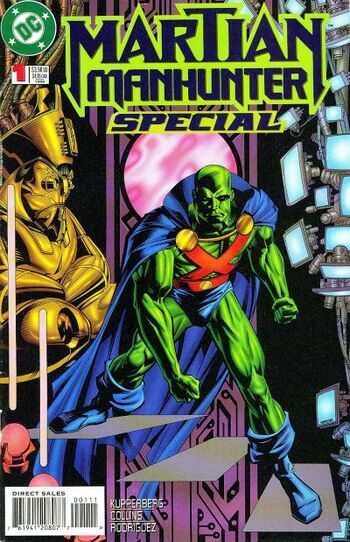
Appearance: He's green, and his classic outfit just looks. . .well, it looks wrong in a modern context. I will admit the suit he had been placed in for his mini-series did indeed look cool, though the colors should be a tad brighter. To my mind J'onn isn't the Grim Avenger. He's not one for rain-slicked streets at midnight. He's one of the last creations of the Silver Age of comics, and while he shouldn't be wearing some weird bathing-suit/suspenders combo with Captain America booties, he should be rocking something a bit more traditionally superheroic.

As to the famous allegations of Morrison, that people can't get past his green skin, nah. One of the most popular movies out there right now features a shapeshifting superstrong protagonist who happens to be green, so I think the concept could be sound. It just needs a hefty injection of the second element

Accessibility: Having a superintelligent shapeshifting alien as your lead character can be a bit detrimental if you're hoping to gain your reader's emotional involvement and sustain it over a long period of time. Consider Spider-Man. He's easily one of the most popular superheroes around, because we can relate to him. Peter Parker may be a bouncing, swinging, dashing young demigod in his red and blue tights, but he's also a guy who has to make his rent, has relationship problems, and deals with a boss who is a total and complete asshat. J'onn J'onzz is a martian who masquerades as human beings, but isn't really one of them. Unlike Superman, he's seen the end of his world firsthand and remembers it's culture, painfully so at times. He enjoys his human friends and cherishes them, but recognizes that he's always going to be a little apart. Hence, the distance and seeming Olympian detachment can work as a detriment to any serious exploration of the character.

So how do we fix this? As always in times of doubt in the best use of genre archetypes and tropes I turn to Doctor Who. The Doctor is an alien, the last of his kind, and incredibly intelligent and clever. He walks among us, looking like us, but isn't really a human being. Over the years we've had the odd story where he's on his own, but most often he's accompanied by a number of human companions. These serve two functions; to provide the audience a vicarious place to put our expectations and observations serving as someone we can relate to, and to also ground the character of the Doctor a bit further into human concerns. I think J'onn needs that in order to be a more successful character. He can look human, makes himself look more human in his 'superhero' appearance, but he needs a human element. He needs someone perfectly normal to ground him, to help the audience see him as less this stern sentinel at the gate and more of a man from far away who wants to help, but isn't all that sure how to relate to us. If we feel we know someone and their point of view, it helps us to become more comfortable with them, to pull for them and understand their problems. A human secondary character (be it a person he meets in his guise as Detective John Jones or someone he saves as the Martian Manhunter he strikes up an unlikely friendship with) would be just what we need to make the character just a bit more human.

But bear in mind we only want a bit more humanity. For by and large the real appeal of the Martian Manhunter lies in the third element.

The Alien: The character of the Martian Manhunter was created during the 1950s, the heady period when the thought of life on other planets was at once thrilling and terrifying. While thrillers like Earth Vs. The Flying Saucers were scaring the bajaysus out of teens in theaters everywhere, Jack Miller and Joe Certa created a hero who'd survived his world's destruction, saw the good in humanity, and wanted to stay and help them meet their potential. With powers and abilities beyond mortal men. . .well, you get how familiar this idea is. And it is painfully easy to see J'onn as a knockoff of Superman(because, y'know, he is exactly that) but the key differences to J'onn's character make him a potential gold mine for storytelling:

1) He doesn't have any dim memories of the cataclysm that destroyed Mars; he was there on the ground when it happened. Only a freak accident, a one-in-a-million-trillion quirk of fate spared him from dying with his people. He remembers his world's science, it's art and culture, it's people with a painful vividness(being of a telepathic people must mean everything new is shared and disseminated across the entire mass consciousness of a people, with maybe the option to pick and choose, a reassuring background noise inside the mind. Now it's just silence). Unlike Clark Kent, J'onn wasn't raised by humans, he arrived on their world as a refugee, a survivor who had to learn to acclimate to his new environment. That he enjoys Earth and likes its people is beside the point. He's not from here and he knows it.

2) That said, he does have the unique vantage point of being Earth's protector, as well as an immigrant who's come to this planet and become quite comfortable with it. He's a booster for humanity as well as a stalwart guardian. With his abilities he's experienced human existence from just about every point of view and enjoys their culture and art with the enthusiasm of an older brother figure. He gets frustrated with the depths humanity can sink to (militarism and humankind's genius for war strikes him very, very White Martian), but at the same time it's tinted with the knowledge that one day humanity will (with luck) inherit the stars the way his people once did. Simply put, in my opinion he's often cast as sort of DC's take on the Silver Surfer, and that isn't the best fit. He's more Doctor than Surfer in my opinion.

3) He's an alien, but he's also a hero. That heroism comes from a desire to see justice done (the Manhunters were an investigatory body on Mars) and to protect the innocent. J'onn should take that duty seriously, but also recognizing as a telepath a fundemental universal truth: doing good deeds feels good. It's giving of yourself for another, creating bonds of camaraderie and friendship. On Mars that feeling must have been even more intense, and by doing his best to help others on Earth, he's keeping the last embers of his heroic life on mars(pardon the pun) alive, while at the same time showing that he's there to help.

So there we go, some problems addressed and potential solutions suggested. Of course, as with anything, your mileage may vary, but I think we can see that the character of the Martian Manhunter has storytelling potential, and could easily carry a series(or at least a series of mini-series). What do you think?

Until next time.

Stac